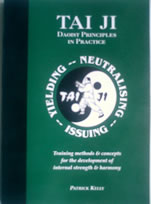
Daoist Principles
in Practice
Taiji - Daoist Principles in Practice contains training methods,
teaching principles and advanced concepts of application. Taiji is explained
as a balanced system for the development of efficient movement, internal strength
and spiritual harmony. At present only available to senior students personally
training with Patrick A Kelly, this book is in the process of being rewritten
for public distribution.
From the Book: Waves of Movement. All fluids move in waves.
Energy moves through fluids either as a transfer of mass with a stored momentum,
or as a wave of elastic displacement that leaves the medium undisturbed once
it has passed. Stored momentum gives a more external force and elastic displacement
a more internal one. Different types of waves appear when we move. Forward
and backward waves are generated from the hips moving horizontally slightly
ahead of the rest of the body. Moving the body in horizontal curves produces
waves in all horizontal directions. Twisting waves are produced by turning
the hips slightly ahead of the rest of the body. Twisting waves wind along
lines of elastic connection between the points of application of force and
the ground. Vertical waves appear when the hips lift and sink before the upper-body.
Adding this vertical dimension produces waves of compression and expansion
up and down the body, which power the lifting and lowering of the arms. Smooth
continuous waves that ripple and interact throughout the body in a complex
and natural manner are a final result of the simultaneous interaction of these
three types of waves.
Learning to produce and regulate these waves requires an intelligently designed
series of steps leading from the simple to the complex. Any section of the
body can be trained to move ahead of the rest of the body, creating a simple
two-part wave. Later, several of these two-part waves can be assembled to create
more complex wave patterns. Two part twisting waves are formed when the pelvis
begins to rotate and the upper-body and arms follow. Two-part vertical waves
are generated by sinking the lower half of the body before the upper half producing
waves of compression and expansion centred in the pelvis. Somewhat controversial,
but supported by experience and logic, is the advancing and retreating of the
lower-body before the upper when two-part forward and back waves appear. Basic
three part waves appear when the lower-body leads the upper-body which then
leads the arm - where the arm is taken to extend from the fingertips to the
lowest point of the shoulder-blade.
One, two, three or more part waves can also appear in any section of the body.
A three part arm wave involving moving first the shoulder then the elbow and
finally the wrist, is used to transmit waves of power from the upper-body to
the hand. From this it is a simple step conceptually to produce a sequence
of movement from the sole of the foot to the finger tips, with a slight delay
at every joint as the muscles, tendons and ligaments stretch. The arms and
legs can also twist in unison with the waist so that the force spirals as it
travels. The sense of this twisting can be given when you visualise a hand
moving over the surface of a ball. Then the palm and forearm rotate as they
move, to maintain contact with the surface of the ball.