Taiji Moving Art
Taiji as a moving art is the training of intention, awareness and intelligence,
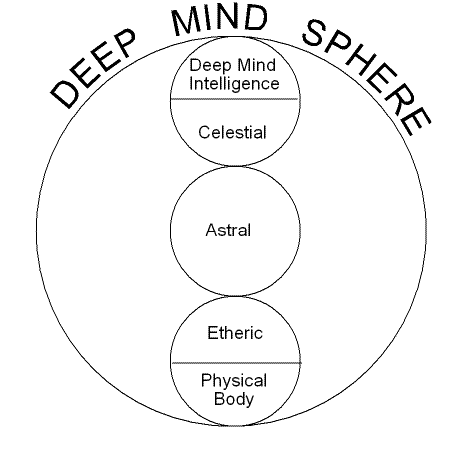
within the energies of the lower-dantien (body and etheric level).
Health Secrets - After 40 years of internal investigation the secrets of good health and long life have become clear.
Your body's intelligence will maintain your health if you give it what it needs then don't interfere. The normal lifespan for a human is around 120 years, but each mistaken interference shortens that span.
These things lengthen your life:
Increase the oxygen circulation.
Increase the blood and lymphatic circulation.
Increase the energy circulation.
These things shorten your life:
Over control or under control of your diet.
Over exercising or under exercising.
Emotional overreaction or underreaction.
...more
Essentials of Elastic Power - Of the 5 muscle changes, contracting, relaxing and holding are obvious and used by all but the 2 hidden phases of stretch and un-stretch are too fast and too subtle to be sensed or controlled from the superficial mind. Zheng Manjing (Cheng Man-Ching) said: 'If you want to know how to use Taiji, then you must know the five elements.' All good old masters of Taiji understand these five types of strength which can be generated within the body
...more
Vertical Circle and the 3 dimensional Dynamic Sphere - Article by Master Li Ya-Hsuan (Student of Yang Cheng-Fu)
In which he argues for lifting and sinking within the Taiji-form which produces the vertical circle and the true 3 dimensional circularity of movement. (Unedited translation).
...more[EN,
FR]
When Active Muscles Lengthen - Technical article on Stretching Active Muscles - When the force applied to a muscle exceeds the force produced by the muscle it will lengthen, absorbing mechanical energy. These eccentric contractions, which result in both braking and storing elastic recoil energy in normal locomotion, require very little metabolic energy, yet they are characterized by high force production
...more
Taiji Waves - Three simple types of waves ripple through the body each time it moves. Transverse waves, Longitudinal Waves and Torsion Waves. Practically speaking every movement is a complex mixture of these types. To visualise these waves:
...more
Taiji Body Alignment - Step 1 (Move): A wave of intention, energy and movement rises...
Step 2 (Release): Align the Lower Body...
Step 3 (Stretch): Align the Upper Body...
Step 4 (Un-stretch): Strengthen the Alignment while issuing 'Spring Force'...
Step 5 (Settle): Intention, energy and body settle naturally
...more[EN,
DE,
FR]
Patrick Kelly's 20 Important Points - Every part of the body changes continuously. 1
Mind and Body aligned within the changes. 2
Elastic strength is transmitted through chains of stretching muscles. 3
...more
Yield, Neutralise & Issue - Yielding, Neutralising, Issuing; Yin-Yin, Yin-Yang, Yang-Yang.
Body Level. Yield: Relax the body and withdraw in the direction of the partner's movement. Neutralise: Release and align the body down to the ground while drawing the partner's body out of alignment.
Issue: Raise Relaxed Elastic Force to combine with the partner's attempt to re-align their body
...more
Beyond Self-defence - Taijii is an art where the soft overcomes the hard, the calm subdues the aggressive and the subtle transcends the gross. Taijii Form develops internal strength, Pushing-hands develops sensitivity. Being externally relaxed while internally strong allows the possibility of resolving pressure without conflict
...more
Higher Martial Arts - Deep Mind based training leads to Higher Martial Arts. Normal superficial-mind based training can never go beyond mere speed, strength and external technique
...more
Questions on the Application of Taiji -
Q. When progressing to the Free Pattern Pushing-hands, do the ideas and techniques from the Fixed Pattern Pushing-hands apply without modification?
A. The situation is different but the method is the same. You must understand and have achieved a degree of naturalness in all aspects of the method of receiving, neutralising and returning the partners efforts as follows: with a relaxed body and sensitive Mind, without resisting and without losing contact, listen deeply to detect your partner’s changes, then withdraw in the exact direction of their energy. Next, by changing direction always a little ahead of the partner, draw them in a gentle curve. When the partner’s energy withdraws, merge with their Mind-energy-body system and release a wave of internal energy. This is practised and refined within the Fixed Patterns and used within the Free Pushing-hands
...more
Yang Family Classics, 40 Chapters - Attributed by the Yang family to Zhang Sanfeng.
Known now as the "Forty Chapters". From the 20th chapter: "As a martial art, T’ai Chi is externally soft, but internally hard, even as it seeks softness. If we are externally soft, after a long time internal hardness will naturally develop. Not consciously cultivating hardness, in reality our mind is on softness. What is difficult is remaining internally reserved, to possess hardness without expressing it, always meeting the opponent with softness. Meeting hardness with softness transforms the opponent’s hardness into nothingness. How to acquire this skill? When we have mastered touching, connecting, merging and following, we will naturally progress from awareness of movement to interpreting energy and finally illumination within the realm of absolute transcendence (Deep Mind). If we have not reached absolute transcendence, how could we manifest the miracle of four ounces leading a thousand pounds? It is simply a matter of understanding the method of merging to the point of perfecting the subtle seeing and hearing."
truetaiji